Verslay
For everyone asking how we're different from Claude

We give Claude what's missing for running a real business.

Verslay runs on Claude. It adds a 135-workflow catalog, 26 connected services, structured business memory, and atomic-agent composition — accessible by typing /verslay_run inside claude.ai.

Live Today · 5 verified layers

Five layers Claude doesn't have today — and Verslay does.

Each one is shipped, observable in code, and reachable inside claude.ai by typing /verslay_run.

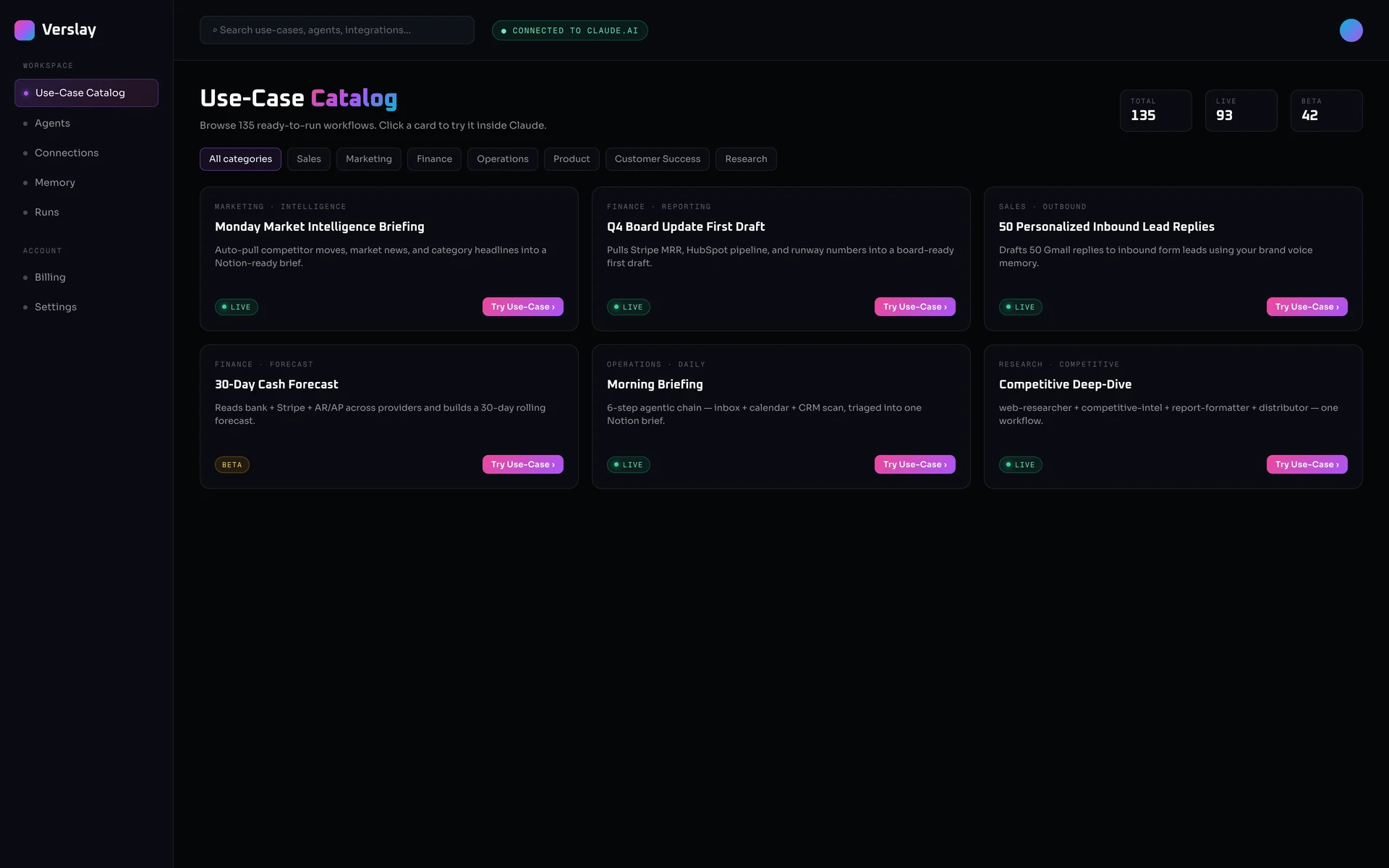
Verslay use-case catalog — grid of cards with quality-grade pills and Try Use-Case buttons
01 / 05Live

The Use-Case Catalog

135 named, ready-to-run workflows — each with defined input fields, a verified output, and a quality grade (live · beta · coming_soon).

In Verslay

Browse the catalog → click "Try Use-Case" → claude.ai opens with /verslay_run <slug> pre-loaded. The MCP server runs the workflow against your connections and returns the output to Claude. Examples: Monday Market Intelligence Briefing, Q4 Board Update First Draft, 50 Personalized Inbound Lead Replies, 30-Day Cash Forecast.

In Claude alone

Each 'workflow' is a prompt you wrote yourself. You refine it over weeks. You store the working version in a Doc somewhere and hope your team uses the latest copy. Each new workflow restarts at zero — no quality grading, no versioning, no shared catalog.

Migration 053 (live/beta/coming_soon enum) · use-case-card.tsx
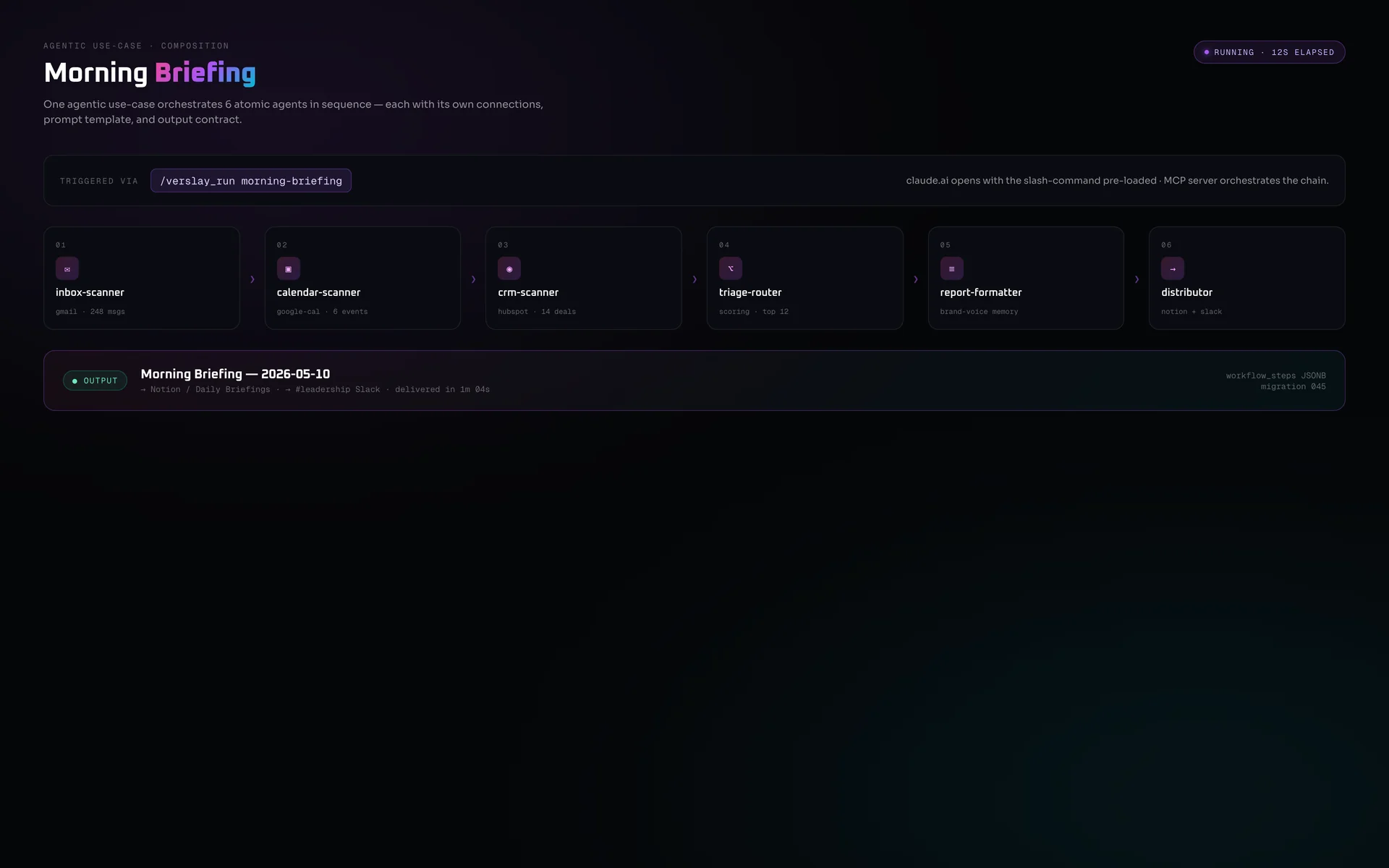
Morning Briefing agentic use-case orchestrating six atomic agents in sequence
02 / 05Live

Atomic Agents → Agentic Use-Cases

12 atomic agents compose into 8 Agentic Use-Cases via workflow_steps JSONB — multi-step business operations as composable building blocks.

In Verslay

The "Morning Briefing" agentic use-case orchestrates inbox-scanner → calendar-scanner → crm-scanner → triage-router → report-formatter → distributor in one run. Each atomic agent has its own connections, prompt template, and output contract.

In Claude alone

Multi-step workflows mean chaining your own prompts manually — paste outputs into the next prompt, switch tabs to fetch data, paste back. The agent boundaries don't exist as composable building blocks.

Migration 045 (atomic agents + agentic use-cases + workflow_steps JSONB)
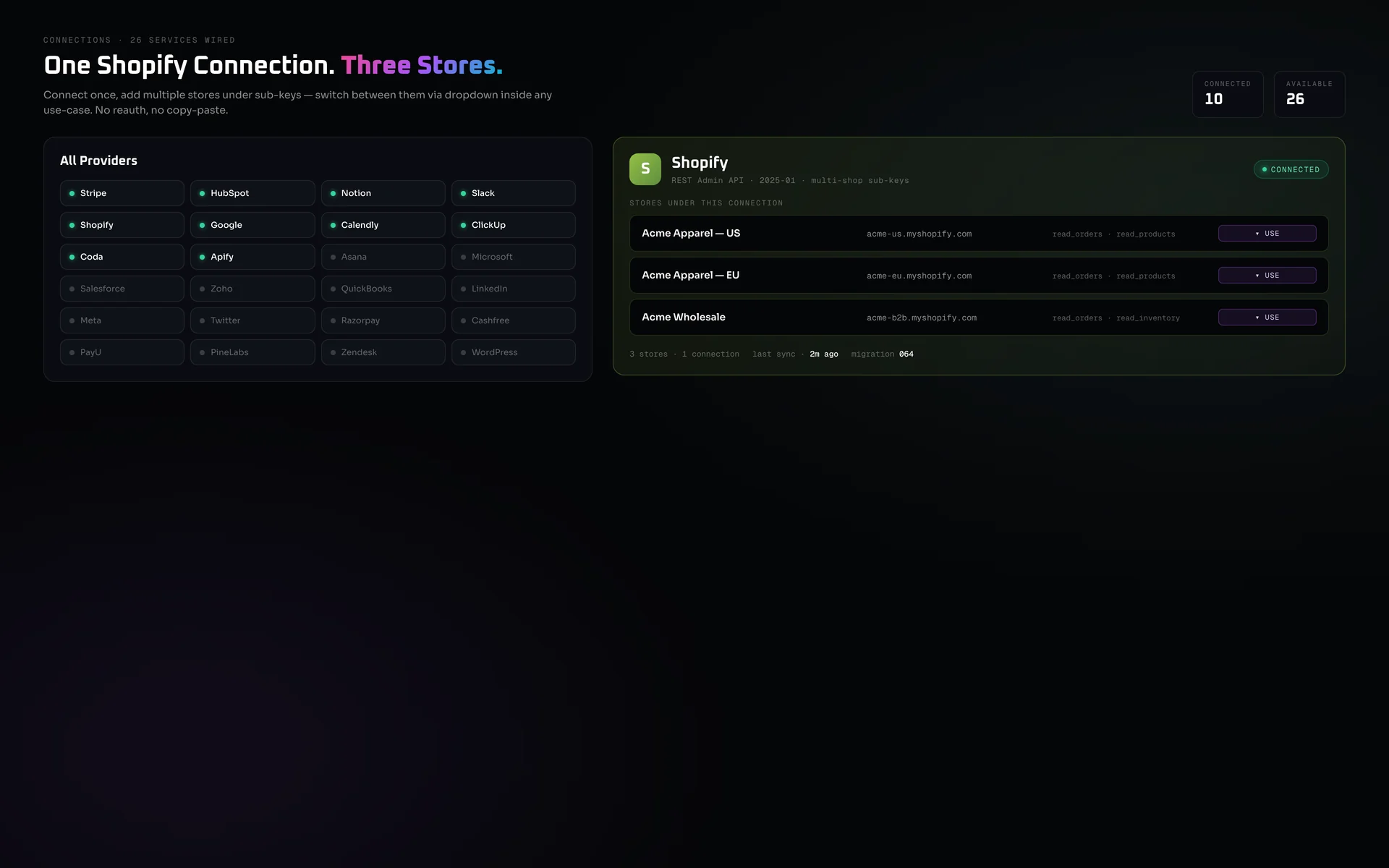
Verslay connections page showing one Shopify connection with three stores under sub-keys
03 / 05Live

The Connections Layer

26 services wired through one OAuth + API-key proxy — including a multi-shop Shopify pattern that no per-user Claude Connector handles today.

In Verslay

Connect Shopify once, add 3 stores under sub-keys, switch between them via dropdown inside any use-case. 26 providers in total: Stripe, HubSpot, Notion, Slack, Shopify, Gmail, Drive, Linear, Asana, Figma, ClickUp, Coda, Apify, and more.

In Claude alone

claude.ai's Connectors are per-user, single-account-per-service. Three Shopify stores = three personal accounts and three reauths. No shared connection state across the team.

Migration 046 (26-provider CHECK constraint) · Migration 064 (multi-shop sub-key pattern)
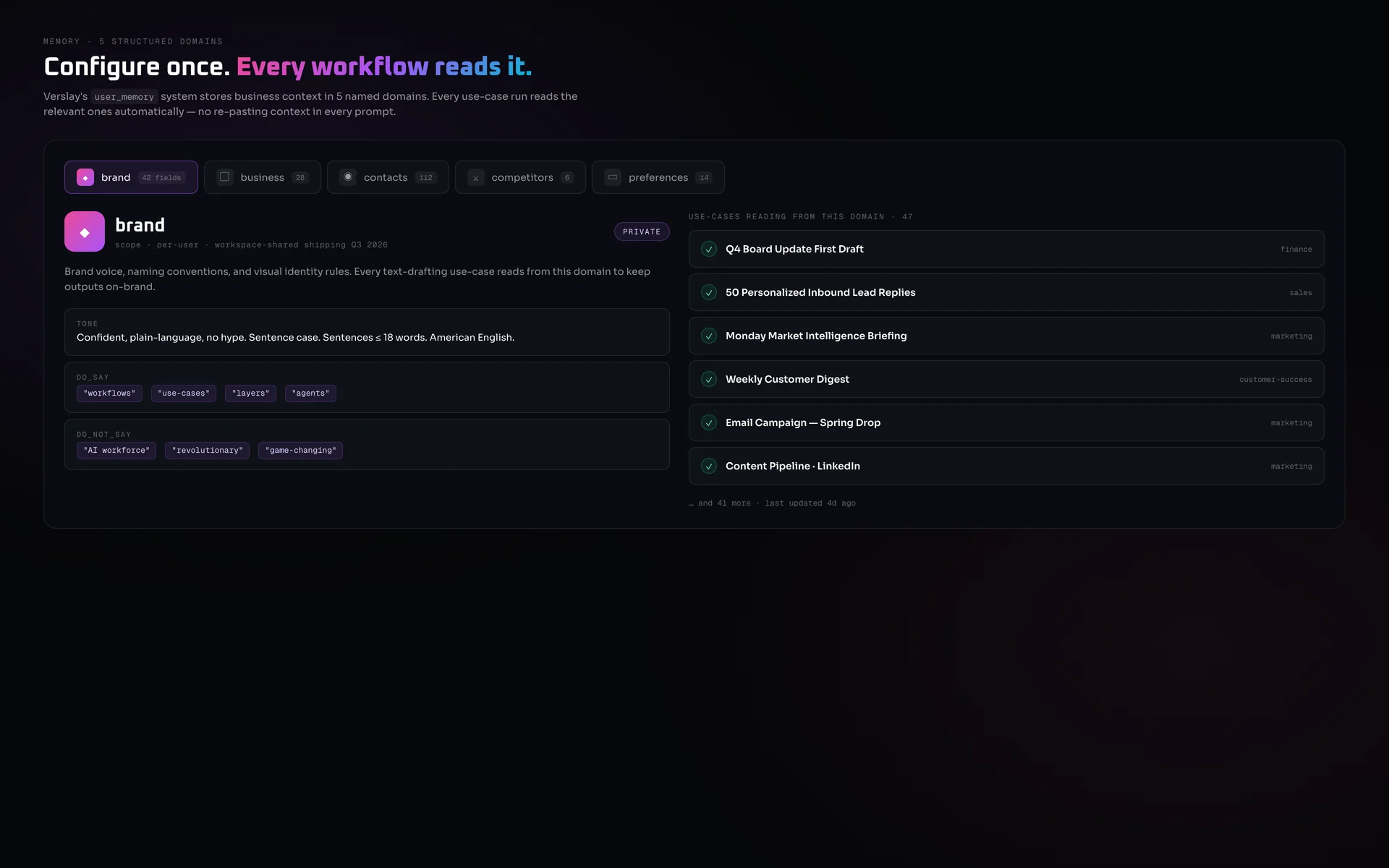
Verslay memory panel with five domain tabs and brand domain expanded showing tone and vocabulary fields
04 / 05Live

Structured Memory Domains

5 named memory domains — brand · business · contacts · competitors · preferences — that every use-case run reads automatically.

In Verslay

Configure your brand voice once in Memory → Brand. Every use-case that drafts text — Q4 board update, lead replies, content pipeline — uses that voice. No re-pasting context in every prompt.

In Claude alone

Claude's memory is unstructured and per-user — it remembers what you've told it, but you can't say 'this fact is brand-scoped' or 'this is a competitor'. You re-state context every time it's relevant.

user_memory table · 5 structured domains · per-user scope today
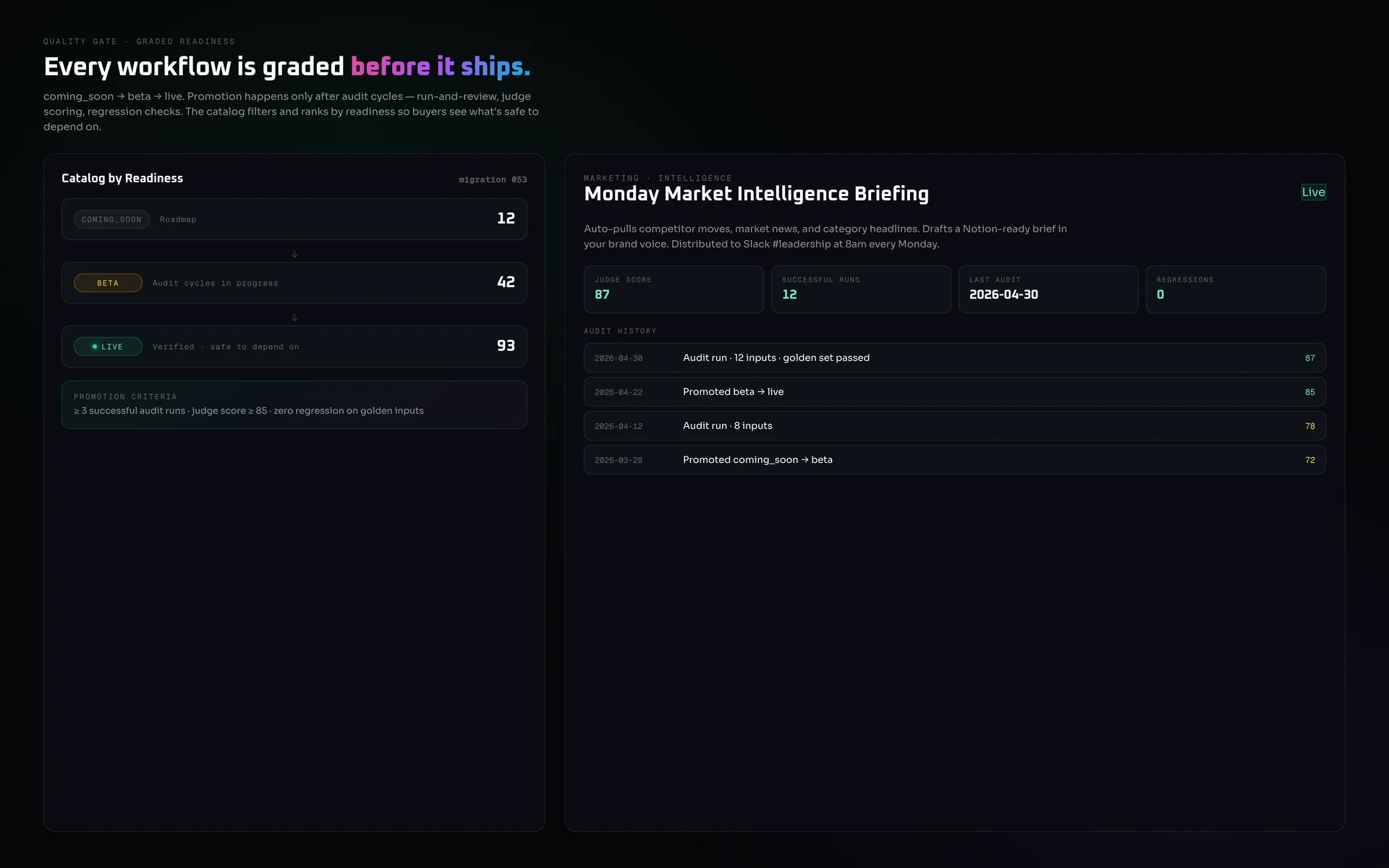
Verslay quality gate funnel — coming_soon to beta to live — with audit history
05 / 05Live

The Quality Gate

Every workflow has a status — coming_soon → beta → live — promoted only after audit cycles (run-and-review, judge scoring, regression checks).

In Verslay

You see live badges on the catalog cards that have passed audit. Beta cards work but may have quirks. Coming-soon are visible as roadmap. The catalog is filterable and rankable by readiness — buyers see what's safe to depend on.

In Claude alone

Your prompt is whatever you wrote. There's no signal about whether anyone else has tested it, no version history, no community-graded 'this works'.

Migration 053 (quality_status enum + transitions)
Shipping Next · 4 layers on the roadmap

Four more we're building.

Clearly labelled — no "soon™" ambiguity. Until they ship, here's exactly what works today and what doesn't.

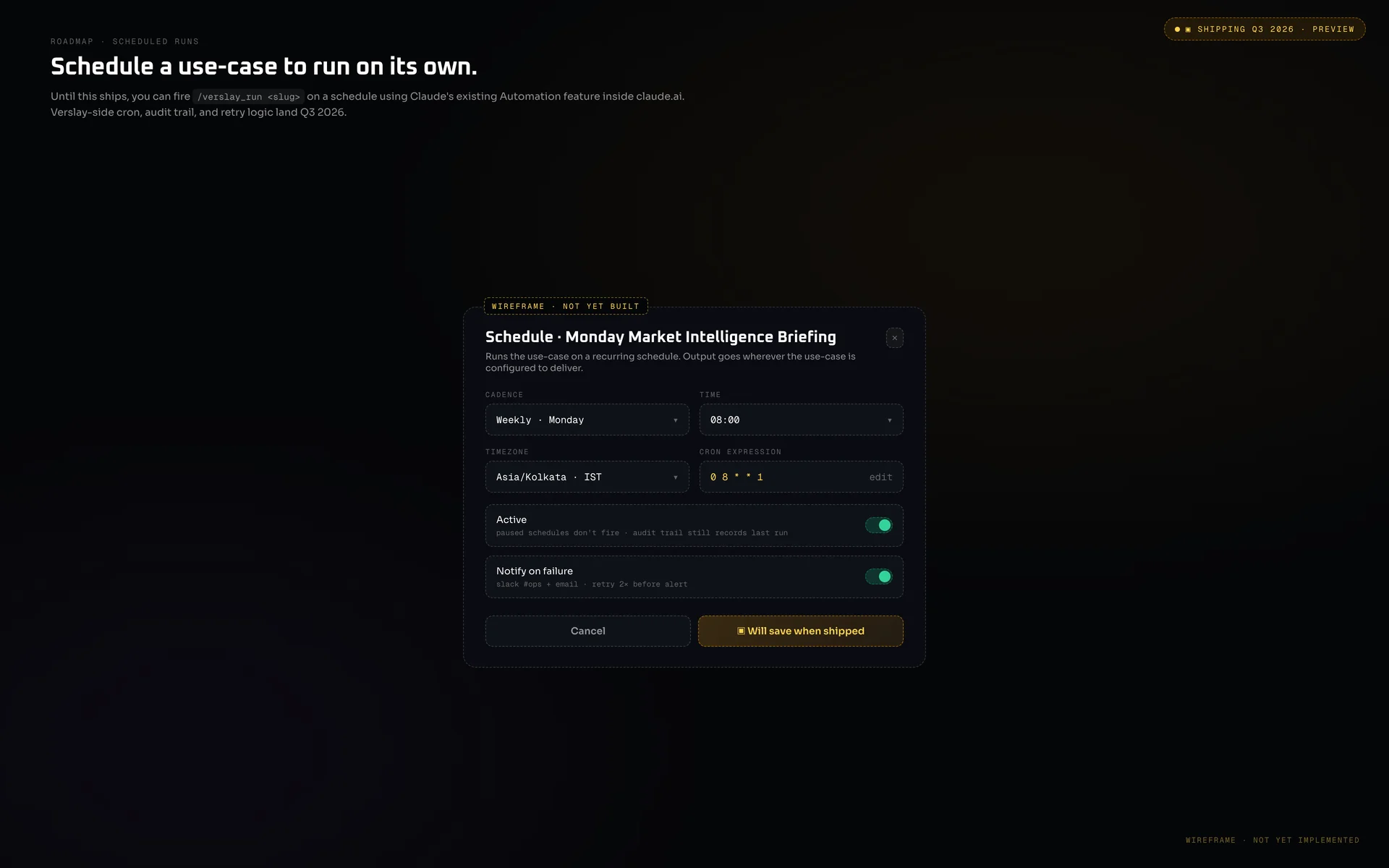
Wireframe preview of Verslay's Scheduled Runs modal with cadence, timezone, CRON expression
06

Scheduled Runs

Shipping Q3 2026
Why we're building it

So your Monday market briefing runs without you remembering to open Claude.

Until then

Use Claude's existing Automation / Scheduled Chats feature on claude.ai to fire /verslay_run <slug> on a schedule. Verslay-side scheduling (cron, audit trail, retry, error alerts) is on the roadmap.

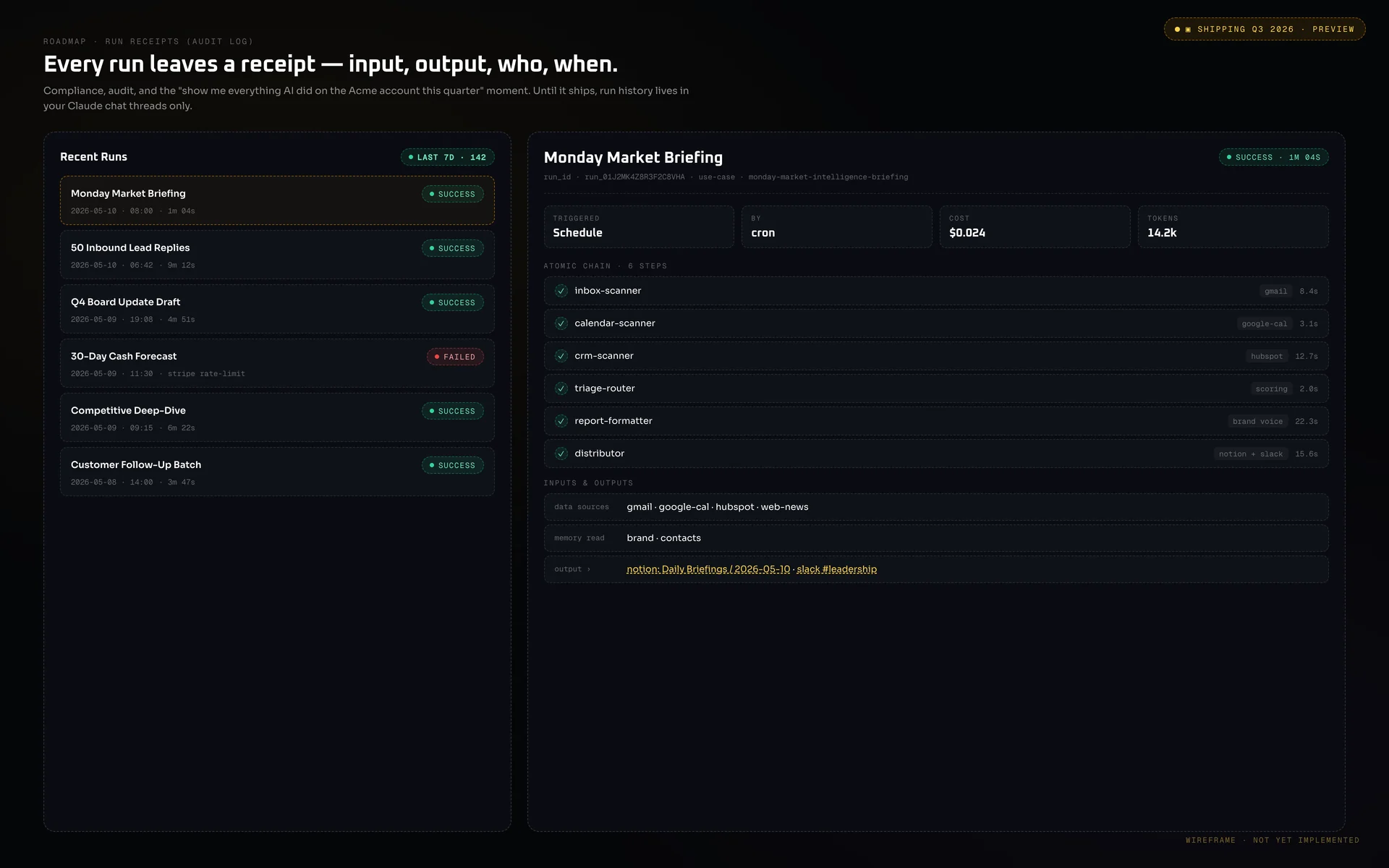
Wireframe preview of Verslay's Run Receipts dashboard with one receipt opened
07

Run Receipts (audit log)

Shipping Q3 2026
Why we're building it

Compliance, audit, and the "show me what AI ran on the Acme account this quarter" moment.

Until then

Run history lives in your Claude chat threads only. The structured run-receipt object — input, output, who triggered, data sources, status, timestamp — is on the roadmap.

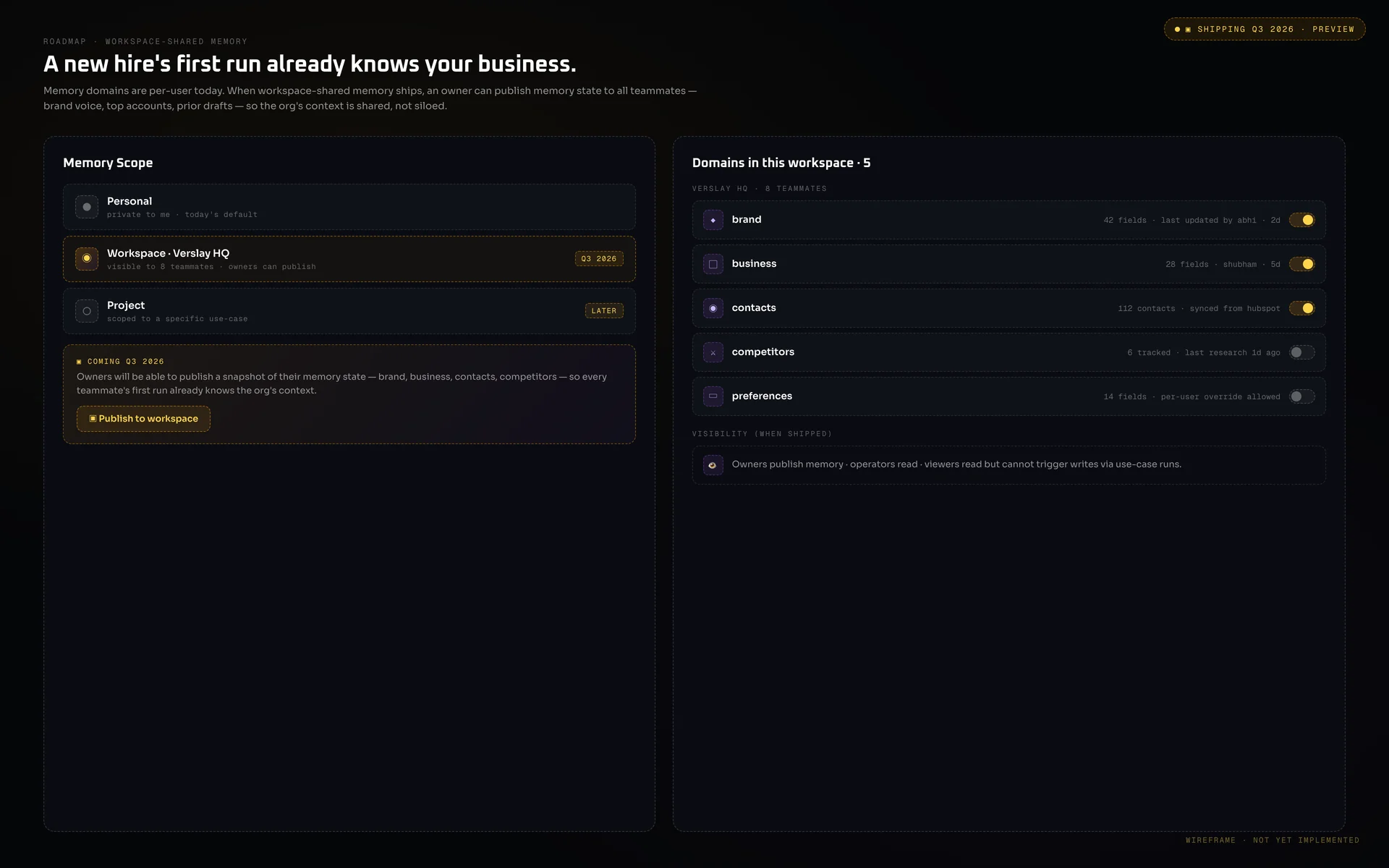
Wireframe preview of workspace-shared memory settings with publish-to-team option
08

Workspace-Shared Memory

Shipping Q3 2026
Why we're building it

So a new hire's first run already knows your brand voice, top accounts, and past drafts — without re-configuring anything.

Until then

Memory domains are per-user today. Workspace-shared memory will let an owner publish memory state to all teammates so the org's context is shared, not siloed.

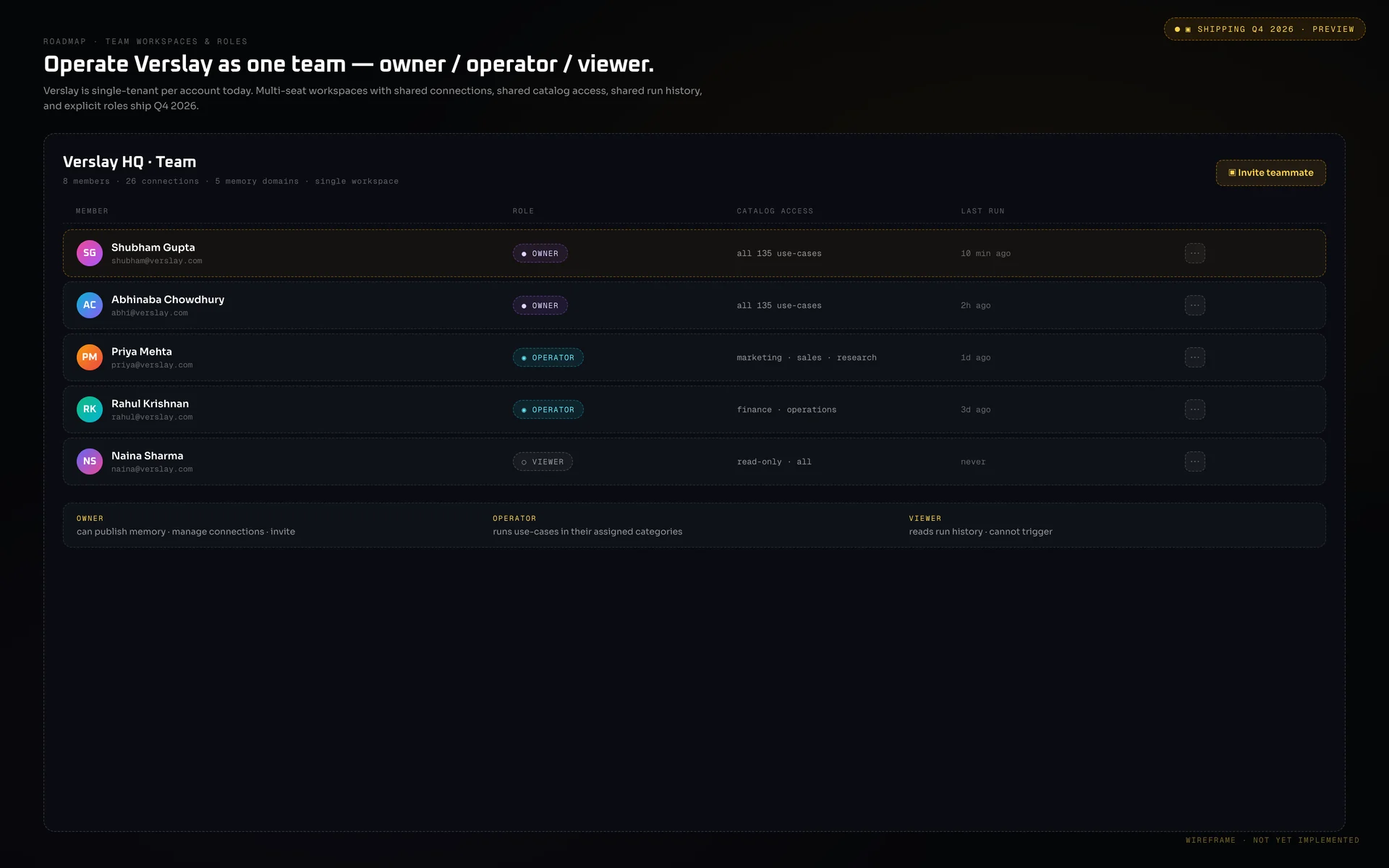
Wireframe preview of Verslay team workspace with role assignments
09

Team Workspaces & Roles

Shipping Q4 2026
Why we're building it

So teams operate Verslay as one — shared connections, shared catalog access, shared run history, with owner / operator / viewer roles.

Until then

Verslay is single-tenant per account today. Multi-seat workspaces with roles is on the roadmap.

Same job · Two paths · Look at the steps

Pick a real job. Compare the steps.

Every row uses only verified Live-Today capability — no scheduling, no team workspaces, no roadmap features.

This week's competitive briefing
In claude.ai

Open chat → paste 8 URLs → paste prompt → wait → copy → open Notion → paste → format → share

8 steps · ~45 min
In Verslay (via /verslay_run)

/verslay_run competitive-deep-dive → enter the topic → Claude runs web-researcher + competitive-intel + report-formatter + distributor → posts to Notion

2 steps · ~3 min
Draft replies for 50 inbound leads
In claude.ai

For each lead: paste lead context → paste prompt → wait → copy → open Gmail → paste → send (×50)

~350 actions · 4–5 hrs
In Verslay (via /verslay_run)

/verslay_run lead-research → Claude pulls lead context from your CRM connection, runs email-writer against your brand-voice memory, drafts 50 Gmail messages

~10 actions · ~10 min
Q4 board update first draft
In claude.ai

Pull Stripe numbers manually → paste into chat → write prompt → copy → open Notion → format

8 steps · ~90 min
In Verslay (via /verslay_run)

/verslay_run weekly-digest configured for Q4 → Claude pulls Stripe + HubSpot via your connections → drafts in your brand-voice memory → posts to Notion

2 steps · ~5 min
Run the same workflow across 3 Shopify stores
In claude.ai

Reconnect Shopify per store + swap context manually each time

7–10 steps per store
In Verslay (via /verslay_run)

One Shopify connection with 3 sub-keys → choose store from dropdown in any use-case

1 setup · instant switch
Make a workflow that knows your brand voice
In claude.ai

Re-paste a brand-voice paragraph into every prompt

Every. Single. Time.
In Verslay (via /verslay_run)

Configure brand voice once in Memory → Brand → every use-case run reads it automatically

1 setup · then automatic
Onboard a non-technical operator
In claude.ai

Train them on prompt-writing → review every output

Weeks
In Verslay (via /verslay_run)

Send them the catalog URL → "Try Use-Case" button on each card opens claude.ai with /verslay_run pre-loaded

2 steps to first run
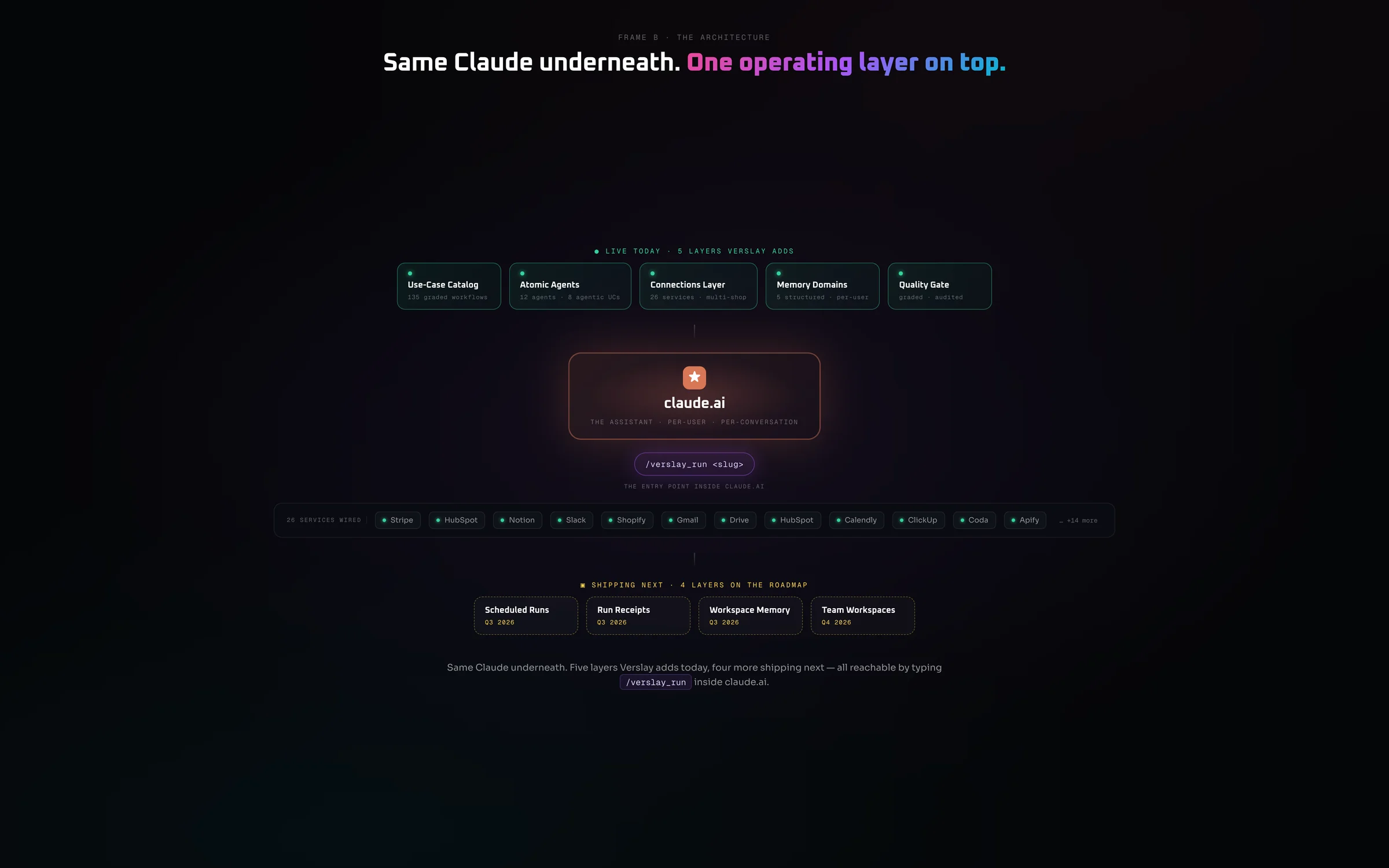
The architecture

Same Claude underneath. One operating layer on top.

Five Live-Today layers and four shipping next, all reachable by typing /verslay_run inside claude.ai.

Verslay architecture — claude.ai with five Live Today layers (Use-Case Catalog, Atomic Agents, Connections, Memory Domains, Quality Gate) and four Shipping Next layers (Scheduled Runs, Run Receipts, Workspace Memory, Team Workspaces) all reachable through /verslay_run
Live Today · 5 layers
  • · Use-Case Catalog (135 graded workflows)
  • · Atomic Agents (12 agents · 8 agentic UCs)
  • · Connections Layer (26 services · multi-shop)
  • · Memory Domains (5 structured · per-user)
  • · Quality Gate (graded · audited)
▣ Shipping Next · 4 layers
  • · Scheduled Runs Q3 2026
  • · Run Receipts Q3 2026
  • · Workspace Memory Q3 2026
  • · Team Workspaces Q4 2026
Three product walkthroughs · 15 seconds each

See it running. Real flows, in motion.

Each 15-second loop walks through a Live-Today layer — the same flow you run inside hub.verslay.com and claude.ai today.

Use-Case Catalog · Quality Gate · Run UX

Browse the catalog → run inside Claude

Open hub.verslay.com, click a use-case card, hit Try Use-Case. claude.ai opens with /verslay_run pre-loaded and the workflow executes through the MCP server.

Run this yourself
Atomic Agent Composition

Atomic agents compose into one workflow

Trigger an Agentic Use-Case (e.g. executive-morning-brief) and watch the chain fire — inbox-scanner → calendar-scanner → crm-scanner → triage-router → report-formatter → distributor.

Run this yourself
Connections Layer

Multi-shop Shopify in one workflow

One Shopify connection holds three stores under sub-keys. Switch via dropdown inside any use-case — no reauth, no copy-paste.

Run this yourself

Claude is the assistant. Verslay is the operating layer that points it at your business.

One slash command, 135 ready workflows, 26 connected services, structured memory.

Open Claude. Type /verslay_run. Pick a workflow.

That's the whole experience. Browse the catalog, connect once, and run packaged business operations from inside Claude.

135 quality-graded workflows·12 atomic agents·26 connected services·5 memory domains·multi-shop Shopify